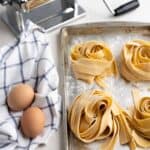
2 Ingredient Homemade Pasta
A recipe that's so easy to remember - two ingredient homemade pasta! This recipe comes together quickly and doesn't take many ingredients, just eggs and double zero flour. Impress family and friends with a rich, silky dough that's perfect for your pasta sauces.
Servings: 4
Equipment
Ingredients
- 4 large eggs
- 400 grams double zero flour
Instructions
- Crack the eggs in a bowl, making sure no shell pieces fall in.
- On a clean and dry workspace, pour the flour and make a well in the center. This will be where you pour your eggs.
- Pour the eggs in the flour well. Poke the yolks and scramble the eggs within the well, making sure to keep the flour walls up.
- Slowly incorporate the flour into the eggs with the fork. The goal is to slowly expand the well while you incorporate the flour into the egg mixture.
- Once most of the egg mixture is incorporated into the flour, use the dough cutter or scraper to incorporate the remaining bits of flour into the dough.
- Knead the dough for about eight minutes or until the dough is smooth. Put the dough in a bowl and cover with a tea towel for 30 minutes to an hour at room temperature. If you're not ready to roll out your pasta dough on the same day that you make it, you can keep it in the fridge for 24 hours.
- Once rested, cut your dough ball into four pieces and shape each piece into a rectangle with your hands so it fits easier into the pasta machine.
- Starting at the widest setting in your pasta machine, roll the dough through. Roll it twice or three times, depending on the thickness of the dough. Then fold your flattened piece of dough twice onto itself (like an envelope) and pass it through the same setting another two or three times. Once it's thin enough, go up one more setting on your pasta machine. You will see that the gap within the rollers will be a bit smaller than the previous setting.
- Keep repeating the previous step until you have a thin dough. On my machine, I start at the 0 setting and go all the way to 5 but depending on how thick/thin you like your pasta, your final setting can be different.
- Once flattened to your liking, you can either cut your pasta shapes by hand (with a sharp knife) or with different settings on the pasta machine (spaghetti, fettuccine, etc). With the final piece, lay out the thin, rectangular sheet horizontally and dust some flour on the top and bottom. Cut off the side pieces to make a rectangle with sharp edges.
- If you're using your pasta sheet for lasagna or ravioli, you can use this flat sheet as-is since you won't need to cut. If you're going to cut by hand for shapes like pappardelle, fold the left part of the rectangle towards the middle of the sheet and the right part of the rectangle towards the middle of the sheet. Then fold the left part of the rectangle towards the right part of the rectangle and cut horizontally. This will produce long strands.
- If you're making long pasta and not cooking it immediately, make some nests to store or freeze. Hold your flour-dusted strands together in your hand and roll them into each other to create a circle, or nest, as seen in the images above. Make sure that you're sprinkling flour on the surface where these will lay so they don't stick to the bottom.
- Once ready to cook, place the cut noodles into boiling water for a few minutes - my pappardelle cooked in about three to four minutes but this can vary depending on the thickness of the pasta shape. Taste test your pasta once it starts floating at the top of the boiling water. Make sure it's al dente, or "to the tooth." You can then toss it in your favorite sauce and enjoy!
- If you're not ready to cook the pasta just yet, keep it in an airtight, flour-dusted container in the fridge for about 24 hours. If you want to freeze the pasta nests, let these dry for about an hour, place in an airtight, flour-dusted container and freeze for up to eight months.
Notes
- Whether you're rolling out your fresh pasta on your dining room table or on your kitchen countertop, make sure you dust and clean the surface(s) you're working on. Anything can stick to this dough so a clean workspace is necessary.
- To make sure the pasta doesn't stick onto itself, make sure your workspace is lightly dusted with the double zero flour.
- It's important to take your time while you roll your dough in the pasta machine. If your dough breaks a bit or is frayed at the edges, you can always fold it like an envelope and go repeat the rolling on the previous setting. So, for example, if your dough frays at setting 3, you can fold it, go back to setting 2, and roll it again until it's flattened and you can move up to setting 3 again.
- Rest your dough. This pasta dough needs to rest for 30 minutes to an hour so that the flour absorbs all the liquid, or eggs, and so the dough is smooth and pliable.
- To make this recipe ahead of time, make your dough and store it in the fridge, covered, for up to 24 hours. Once you're ready to cut, take it out of the fridge and let it come up to room temperature. Immediately after that, you should start the process of flattening, cutting and cooking it.
- If you plan on using your pasta within the next day after cutting it, keep it in an airtight, flour-dusted container in the fridge for about 24 hours.
- If you want to freeze the pasta nests, let these dry for about an hour, place in an airtight, flour-dusted container and freeze for up to eight months.
Tried this recipe?Mention @AFabulousBite or tag #AFabulousBite!
